Essential Tools and Platforms for Hosting Your Online Course
CourseAI Team
Jun 17, 2024
7 min read
In the rapidly expanding realm of online education, choosing the right platform and tools to host your courses can significantly impact the success and scalability of your offerings.
Platforms such as Learning Management Systems (LMS) and various other offerings provide the backbone for delivering content, managing participants, and facilitating interactions. However, there are plenty of these platforms out there–do you know which ones are perfect for hosting your online course?
This article explores some of the most popular and effective tools and platforms for online course delivery, including insights into how CourseAI leverages these technologies to offer a superior learning experience.
Understanding Learning Management Systems (LMS)
Learning Management Systems (LMS) are software applications that provide the framework that handles all aspects of the learning process—it's where you create, manage, and deliver your online courses.
Note
An LMS can be used for all kinds of learning activities but is especially useful for e-learning needs.
Key Features to Consider:
These features are designed to make online learning more accessible, engaging, and effective.
Feature Category
Description
Additional Features by CourseAI
User Interface (UI)
An intuitive and easy-to-navigate UI is crucial for both students and instructors.
Customizable dashboards
Content Management
Supports various content formats including text, video, and interactive content.
AI-powered content generation and management
Assessment and Tracking
Tools for creating assessments and tracking student progress.
Automated grading and real-time performance tracking
Communication Tools
Integrated tools for emails, forums, and live chat to facilitate communication.
AI-driven chatbots for instant query resolution
Mobile Compatibility
Ensures accessibility from mobile devices, enhancing learning flexibility.
Optimized mobile interface for seamless learning
Analytics and Reporting
Not previously mentioned, but crucial for understanding student engagement and improving course effectiveness
Advanced analytics for detailed insights on usage
Popular LMS Platforms
Several LMS platforms dominate the market, each with unique features and capabilities. Here's a look at some of the top choices:
Moodle
Moodle is one of the most widely used open-source LMS platforms around the world. It's highly customizable, making it suitable for both small educational programs and large enterprises. Moodle supports a range of plugin integrations and has a robust community of developers.
Blackboard
Blackboard is known for its comprehensive set of tools which support not only course management but also analytics, accessibility, student safety, and integration with student information systems. It's particularly popular in higher education institutions.
Canvas
Canvas excels in providing a clean, user-friendly interface that is highly favored by educators and students alike. It offers excellent tools for collaboration, including a conference feature and a shared workspace for projects.
Thinkific
Ideal for individual educators and smaller organizations, Thinkific provides a user-friendly platform with a strong focus on marketing tools to help sell and promote courses.
Teachable
Teachable is another popular choice, especially for entrepreneurs and small businesses. It offers powerful tools for course creation, marketing, and sales, with a heavy emphasis on user engagement.
CourseAI: Integrating with LMS Platforms
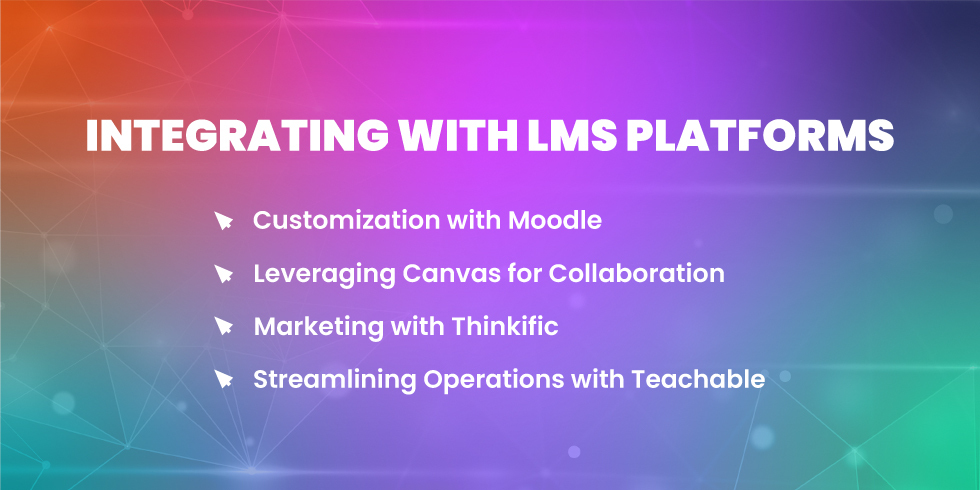
CourseAI utilizes these platforms to host its wide array of courses, choosing the right LMS based on specific course needs and audiences.
Here's how CourseAI enhances its offerings through the strategic use of these platforms:
Customization with Moodle
CourseAI uses Moodle for courses requiring heavy customization. By leveraging Moodle's extensive plugin directory, CourseAI tailors the learning environment to match specific educational needs and learning outcomes.
Leveraging Canvas for Collaboration
For courses that involve significant group work and collaboration, CourseAI prefers Canvas. Its intuitive design and collaborative tools make it ideal for facilitating student interaction and engagement.
Marketing with Thinkific
When launching new courses aimed at professionals and businesses, CourseAI is best used with Thinkific. The platform's strong marketing tools help in effectively reaching and enrolling the target audience.
Streamlining Operations with Teachable
For courses that are more straightforward and require less customization, CourseAI opts for Teachable. Its ease of use for course creators and participants alike makes it a reliable choice for efficiently managing and scaling operations.
Other Essential Tools
In addition to LMS platforms, several other tools are essential for delivering high-quality online education:
Zoom
As a popular app you may already be familiar with, Zoom is a popular video conferencing tool that enables live virtual classrooms, webinars, and meetings, enhancing real-time interaction between instructors and students.
Google Workspace
Google Workspace offers a suite of cloud-based productivity tools like Docs, Sheets, and Slides which are essential for collaborative course work and document management.
SurveyMonkey
An invaluable tool for creating surveys and collecting feedback from students, SurveyMonkey helps educators improve course content and delivery based on direct learner input.
Slack
Slack facilitates efficient communication and collaboration not just between students, but also among course creators, tutors, and administrative staff.
Microsoft Teams
Teams is not only a powerful tool for live communications but also integrates well with Office 365, making it ideal for courses that utilize Microsoft resources.
Conclusion

As online education continues to evolve, the flexibility to integrate and utilize various tools will remain a key factor in the success of online course creators. The platforms discussed offer a range of functionalities that cater to different teaching styles and learning environments.
Selecting the right platform and tools to host your online courses involves understanding the specific needs of your educational offerings and your audience.
CourseAI's approach to using multiple platforms based on course specifics demonstrates the effectiveness of tailoring your tool selection to enhance course delivery and learner satisfaction.
Get Started with CourseAIC
CourseAI Team
The CourseAI team writes practical guides to help course creators build, launch, and grow their online course businesses using AI-powered tools.
Ready to create your own online course?


The most advanced AI online course generation platform. From idea to live course in under 2 minutes.
Stay Updated
Latest strategies, guides, and tips on online courses and financial freedom.